


This post may contain affiliate links. If you make a purchase through one of these links, I earn a small commission at no extra cost to you. Read my full disclosure here.
The Silly Goose Etsy trend has been having a moment, and for Etsy print-on-demand sellers, the opportunity is bigger than putting one cute bird on one toddler shirt.
This theme works because it connects a playful phrase with a specific buying moment: a child’s birthday. That gives you a recipient, an occasion, a visual direction, and several products that can work together.
The catch is that a trend signal is not a permission slip to design twenty products before breakfast.
Search activity can move fast, public Etsy result counts can be messy, and a phrase that looks promising at the trend level may be far more competitive once you attach it to a sweatshirt, blanket, or party favor.
The smarter move is to treat this as a collection concept that deserves validation. You want to understand the buyer, choose products that make sense for the celebration, create original artwork, and test a small group of listings before you scale.
That is how trend research supports a freedom-first business instead of becoming another reason to spend all week refreshing eRank.

DONE-FOR-YOU ETSY RESEARCH, DELIVERED WEEKLY
Stop Guessing What to List Next
Every week, get one in-demand Etsy keyword with low competition, a video breakdown, and nine products already selling for that keyword. This done-for-you research saves you hours and gives you real Etsy market evidence that AI cannot currently produce on its own.
Included with Freedom Unclocked, or available separately for $9 per month.
See What Is Inside the Opportunity Report
Start My $9/Month ReportWhy This Birthday Theme Is Worth Watching
Recent Etsy search reporting from eRank’s August 2026 US keyword analysis showed strong activity around birthday-related searches, including a new low-competition phrase built around a playful goose theme. I am deliberately keeping that vetted phrase out of this free article, but the broader behavior is useful: shoppers are responding to funny, specific birthday identities rather than generic birthday graphics.
That distinction matters. A broad search such as “first birthday shirt” may have demand, but it also puts a new seller in a packed aisle. A theme gives the shopper a reason to stop. It can connect the invitation, outfit, family apparel, nursery keepsake, and party details without relying on a licensed character or a copy of someone else’s bestseller.
Current marketplace data should still be treated as directional. eRank is a third-party research tool, and public Etsy result pages can include unrelated listings. Etsy’s own Marketplace Insights guidance explains that its tool uses real Etsy search data to show demand and competition. Etsy also reminds sellers that a searched term can appear in the data even when using it on a listing would violate a policy or another party’s rights.
If trend research still feels like a guessing game, start with my guide to using Etsy trending searches to boost sales. It explains how to move from “this looks popular” to a product decision with an actual reason behind it.
Start With the Buyer, Not the Goose
The person buying a first-birthday item is usually not the one wearing it. A parent, grandparent, aunt, uncle, godparent, or family friend is shopping for a child and thinking about photos, party coordination, keepsakes, and whether the item will arrive on time.
That creates several emotional jobs for the product. The birthday shirt needs to look good in photographs. A family sweatshirt should feel coordinated without making every adult wear the exact same design. A blanket should feel personal enough to keep after the party. A tote or favor item needs to be useful, not clutter disguised as a theme.
Before you open Canva or an AI image generator, write a one-sentence buyer moment. For example: “A parent wants a playful first-birthday outfit and one keepsake that feels coordinated but not mass produced.” That sentence will do more for your collection than a folder full of random goose clip art.
This is also where shop fit matters. If your Etsy shop already serves parents, grandparents, personalized gifts, or children’s celebrations, this idea may be a natural extension. If your shop sells minimalist office humor to accountants, a nursery goose collection could confuse your existing buyer. A trend can be attractive and still be wrong for your shop.
Silly Goose Birthday Gifts That Make Sense for POD
A good collection does not need ten unrelated products. It needs a small group of items that belong to the same buying moment.
The Birthday Outfit
A toddler shirt or bodysuit is the most direct entry product. Keep the design readable in a thumbnail and easy to photograph. One original goose, a small party detail, and a restrained palette will usually communicate faster than a complicated scene.
If you offer personalization, decide what can change before you build the listing. A child’s name, age, or date may work. Do not promise free-form edits that force you to redesign the art for every order. Personalization should increase value without turning a passive-income product into a custom design job with a twenty-message inbox.
Coordinated Family Apparel
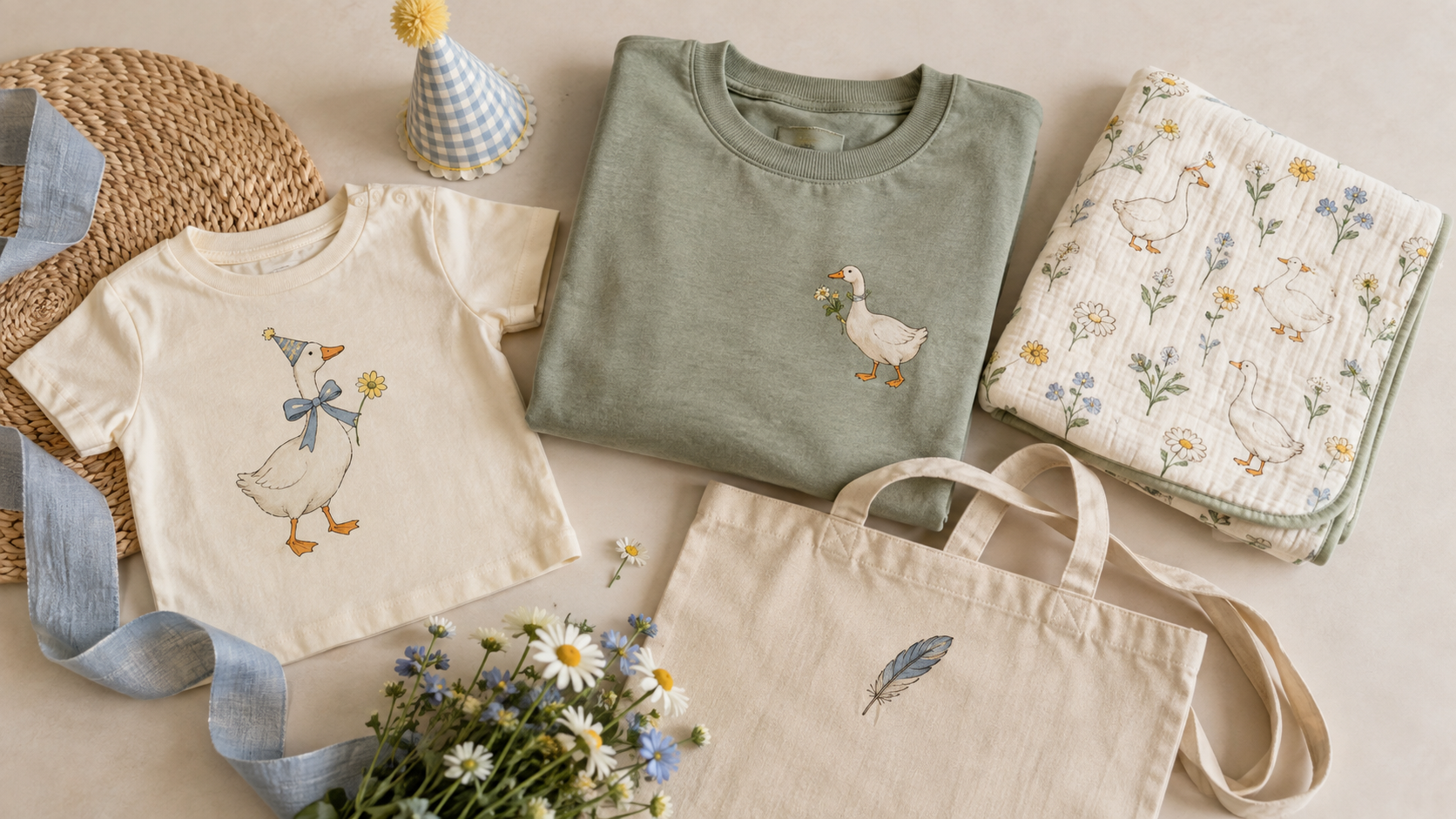
Parent and grandparent apparel can raise the order value, but matching does not have to mean identical. Keep the same illustration style and palette while changing the small motif or relationship label. The child’s shirt can carry the hero goose. The adult crewneck might use a tiny feather, party hat, or secondary goose pose.
This approach gives the family a coordinated look for photos while making the adult pieces more wearable after the party. You can use Printify’s multi-product listing feature when the product setup supports it, but confirm the current options before combining products. A convenient listing structure is only useful when the variants, mockups, and fulfillment details remain clear.
A Nursery Keepsake
A blanket gives the theme a longer life. Instead of printing the same shirt graphic at a larger size, create a companion pattern or a quieter corner design. A subtle goose-and-wildflower repeat, a birth date, or a small name treatment can feel more appropriate for a nursery and more giftable to a grandparent.
Make sure the decoration method suits the artwork. Tiny lines, pale details, and complicated texture may disappear in production. Order a sample when you are testing a new provider, fabric, or print style. A beautiful mockup cannot rescue a muddy blanket.
Supporting Products
A tote, mug, pillow, or small wall print can support the collection, but each product needs a reason to exist. A tote may become the party-day carryall. A mug is more likely to appeal to a parent or grandparent than to the child. A pillow can extend the design into the nursery. Choose one supporting product after the core outfit and keepsake are solid.
If you are new to this business model, read my Etsy print-on-demand beginner’s guide before building a large catalog. Product choice, fulfillment, pricing, and customer expectations still matter when the artwork is trend-led.
Validate the Opportunity Before You Design
The fastest way to waste a good trend is to validate the theme once and assume every product attached to it will sell.
Buyers may search for a birthday shirt and show no meaningful interest in a matching tumbler. They may want a personalized blanket but ignore a generic poster.
Start inside Etsy Marketplace Insights. Search the product and occasion together, then compare demand and competition.
Etsy currently provides fifteen free weekly searches, while Etsy Plus sellers receive unlimited searches during the tool’s beta period. Check the current terms in your account because platform features can change.
Then use eRank to look at related searches, trend history, click-through behavior, and competition clues. One exciting month is a signal, not proof of evergreen demand. Look for a phrase that has enough buyer activity to justify your time and a level of competition your shop can realistically enter.
Review the first page of Etsy results like a buyer.
- Are the products actually similar to what you plan to sell?
- Do the thumbnails all look the same? Are personalized products dominating?
- Is the result count inflated by invitations, digital downloads, or unrelated bird designs?
- Public counts are especially easy to misread when a phrase has several meanings.
Finally, check the economics. Estimate the base product cost, shipping, Etsy fees, personalization time, and the price shoppers appear willing to pay.
A low-competition phrase tied to a product with no workable margin is not an opportunity.
Build One Cohesive Collection
Once the data supports a product direction, build a visual system before you build individual designs. Choose a palette, line style, character proportions, and a short list of supporting motifs. For this theme, a restrained system might use warm cream, butter yellow, sage, and dusty blue with one hand-drawn goose, small wildflowers, a party hat, and a ribbon.
Create one hero illustration first. Test it at the actual print size and at Etsy thumbnail size. Then derive the rest of the collection from that approved artwork. Change the goose pose, scale, secondary motif, or product placement one variable at a time. This protects cohesion and makes it easier to identify which change improved the design.
AI can help with ideation and controlled variations, but it still needs direction and review. Do not ask for “ten cute goose designs” and accept the first ten outputs. Specify the composition, palette, print constraints, and negative space.
Inspect feet, feathers, eyes, line weight, and transparency. Then inspect the smallest mockup, because buyers often meet your design as a tiny square on a phone.
Your collection also needs mockup consistency. Use the same room, lighting direction, background family, or styling details across the listing images. A coordinated set should look like it came from one shop, not five unrelated mockup bundles.
Differentiate Without Making the Design Complicated
Search results full of white geese and party hats can make sellers think the only way to stand out is to add more. More flowers. More words. More textures. More clip art circling the poor bird until nobody can tell what the shirt says.
Differentiation can be quieter. Try an unusual but wearable palette, a recognizable illustration style, a smaller placement, a coordinated family concept, or personalization that supports the occasion. You could create a storybook goose, a folk-art goose, a loose ink sketch, or a modern geometric bird. Pick one direction and own it.
The product combination can also be the differentiator. Many sellers stop at a shirt. A polished outfit plus keepsake pairing may solve more of the buyer’s problem.
A grandparent gift tied to the same party may reach a second purchaser. An invitation designer could partner with a POD seller, provided both parties agree on licensing and responsibilities.
If you need help turning one aesthetic into a practical product plan, my guide to using 2026 Etsy trends for POD walks through the difference between admiring a trend and building listings around it.
Keep the Theme Original and IP-Safe
A goose is not owned by anyone. A specific illustrated goose, character, logo, storybook style, movie costume, catchphrase, or branded party design can be protected. The safest creative direction is to draw or commission your own character and build your own supporting world around it.
- Do not copy the pose, facial features, accessories, colors, or composition of a bestselling listing. Changing two details does not make copied artwork original.
- Do not pull art from Pinterest and treat it as a commercial-use library.
- If you purchase elements, read the license and confirm that print-on-demand use is allowed.
Search phrases deserve review too. Etsy states that sellers remain responsible for ensuring their items and terms comply with the Seller Policy. Search the USPTO database and relevant international trademark databases before committing to wording.
If a phrase is associated with a brand, entertainment property, or existing merchandise line, you may want to choose another route and get legal advice when the risk is unclear (this is not legal advice).
Generic descriptors still need to match the product. Etsy’s search guidance recommends relevant phrases and varied terms for similar listings.
It also encourages sellers to watch Shop Stats and make measured changes. That is a much stronger plan than pasting the same trend phrase into every title and hoping the algorithm feels generous.
Final Thoughts
Silly goose birthday gifts offer a useful Etsy POD test because the theme connects a visual idea to a real celebration and several gift buyers. The opportunity is not in copying the first goose shirt you see. It is in pairing current demand with an original point of view, products that belong together, and a small test you can evaluate without taking over your entire shop.
Use public trend reports to notice movement, Etsy Marketplace Insights to check current buyer searches, and your own shop data to decide what deserves expansion.
If finding and validating trends is the part that keeps slowing you down, the Opportunity Report gives you done-for-you research each week for $9 per month and is included for Freedom Unclocked members.
DONE-FOR-YOU ETSY RESEARCH, DELIVERED WEEKLY
Stop Guessing What to List Next
Every week, get one in-demand Etsy keyword with low competition, a video breakdown, and nine products already selling for that keyword. This done-for-you research saves you hours and gives you real Etsy market evidence that AI cannot currently produce on its own.
Included with Freedom Unclocked, or available separately for $9 per month.
See What Is Inside the Opportunity Report
Start My $9/Month ReportThe Best Resources for Your Print on Demand Business:
These are the resources I use for my multi six-figure Print on Demand business!
Canva: Canva is the most amazing tool. It is user friendly, and always improving! The tools that Canva has have evolved so much since I first started using it in 2022 for the better. I use it almost everyday. I use it to create designs, to edit AI designs, and to create product mockups.
Ideogram: Ideogram is an AI design tool that generates high-quality graphics with exceptionally accurate text rendering, making it ideal for creating quote-based and typography-focused designs. I also use the prompt based editing for mockups, making it a wonderful alternative to Photoshop, which is expensive.
E-Hunt: E-Hunt is fantastic for competitor research and some light keyword research. My favorite aspect of E-Hunt is the Chrome extension that allows you to see the sales amount for an individual item on Etsy. Check out this article to see an example.
eRank: eRank is an SEO data tool that also allows you to search the competition and will also give you key words for your Etsy listing. It is also a low cost tool that will help you find low competition and highly searched niches.
Printify: Printify is a print-on-demand (POD) service that allows individuals and businesses to create and sell custom-designed products without needing to manage inventory or handle fulfillment. I put my designs on products offered by Printify. When an item sells, Printify prints and ships to my customer.
ProfitTree: is the tool I use for profit analysis and AI-powered analysis of all of my Etsy shops. I use ProfitTree’s MCP connect to ChatGPT/Codex to my account and can run all sorts of analyses using my own data! I can even do demand research all inside ChatGPT (also works inside Claude).
AnywherePOD: AnywherePOD is the tool I use for automation and diving into personalization. I can bulk upload products to Printify, which is a game changer. AnywherePOD also has an AI Assistant that can bulk upload designs, multi-design and multi-variant listings! If you want to list and grow faster, you need AnywherePOD.
Vela: Vela is the bulk editing tool I use to manage hundreds of Etsy and Shopify listings without losing my mind. You can update videos, photos, titles, tags, descriptions, and prices across your entire shop in minutes, and your VA can build listings inside Vela without needing your Etsy login. Read more about Vela here.
Shopify: Shopify is what I recommend when you are ready to scale beyond Etsy and diversify where your products sell. The fees are lower, you own your customer data (emails), and it integrates directly with Printify and Vela. It is the easiest way to build a standalone storefront that you control. Read more about Etsy v Shopify here.
FAIRE: FAIRE is the wholesale marketplace I use to sell my products to retail, brick and mortar stores. If you want to scale your shop and add a wholesale revenue stream to your POD business, FAIRE is a great option. Read more about FAIRE here.
📌 Share on Pinterest

Looking for more information on print on demand? Check out these articles:
- Gotcha Day Pet Gifts: What To List Now
- Etsy Digital Downloads Can Become Physical Prints: Should POD Sellers Worry?
- Etsy POD Christmas Trends 2026: 7 Gift Ideas to Test Now
- Etsy POD Trends for Q4 2026: 3 Opportunities to Test Now
- Etsy Shared Access: How to Add Team Members to Your Shop
- Memento Mori Gifts: The Best Etsy POD Ideas to Test
- Etsy Trends Search: Nature Journaling Gifts What to List Now
- Etsy Live Preview for Custom Listings: The Ultimate Guide to Setting It Up
- Calculating Etsy Fees for POD Sellers: Your Ultimate Guide
- Etsy Fall Home Decor Trends: What To List Now
- Etsy v Shopify for Print on Demand: Which One is Actually Right For You?
- The Ideogram Background Remover is Here
- Etsy’s Personalization Update: What POD Sellers Need to Know
- How to Price Print on Demand Products on Etsy
- Lifestyle By Design: The Ultimate Inspiration
- How to Set Up Printify Step-By-Step: The Ultimate Guide
- The Best Print on Demand Products to Sell on Etsy
- Etsy Tags: The Complete Guide to SEO Visibility
- Ideogram Custom Models: Game Changer For Print on Demand
- The Best AI Image Generators for Etsy POD Sellers
- Printify’s New Multi-Product Listing: Game Changer for Esty POD Sellers
- How I Retired at 42: My Story and Best Advice
- eRank vs Everbee vs Alura: The Best SEO Tool Is…
- The Be Do Have Mindset: The Best Way to Thrive on Etsy
- Etsy’s New Review Ratings Calculation: What Print on Demand Sellers Need to Know (And What Etsy Isn’t Saying)
- How to Scale Your Etsy Print on Demand Shop
- Etsy Seller Trend Report Spring and Summer 2026: What POD Sellers Need to Know
- Passive Income for Artists: How to Sell Your Art on Etsy with Print on Demand
- How to Get Vela and Finally Scale Your Etsy Print on Demand Shop Like a CEO
- Closing a Chapter in Life: Leaving Burnout Behind And Starting Over Abroad
- How A Multi Six-Figure Shop Owner Tells You How To Use eRank for Etsy Print on Demand
- eRank vs Etsy Marketplace Insights: Which SEO Tool Is Best?
- Etsy Spring Trends for 2026: The Best Post-Christmas Boost
- The Best Etsy Print on Demand Course And Why
- Ideogram’s Prompt Based Editing Makes It One of The Best Mockup Creation Tools for Etsy POD Sellers
- Is Etsy Still Worth It in 2026? An Honest Answer From Six-Figure Seller
- The Best Art Prompt Generator for Etsy POD Sellers
- Etsy Trends for 2026: The Ultimate Guide for POD Sellers on How to Turn Pinterest’s Predictions Into Sales
- Amazon Print on Demand Opens New Income Stream for Sellers
- Print on Demand Market Growth is Booming: How to Ensure Your Etsy Shop Will Too
- Etsy Trending Searches 2026: What Buyers Want Right Now (And How POD Sellers Can Cash In)
- Amazon Handmade vs Etsy: Which Platform Is Better for Handmade Sellers?
- What Is Faire? Guide for Etsy POD Sellers
- Is Etsy Plus Worth It? An Honest Breakdown From a Multi 6-Figure Etsy Seller
- How Many Listings Should I Have on Etsy?
- How to Use Midjourney Privately
- How to Use the Midjourney Seed Parameter for Consistent Print-on-Demand Designs
- How to Use Midjourney Stylize for Better Design Results
- How to Use Etsy Marketplace Insights
- Should I Change My Etsy Titles?
- Etsy vs Redbubble: Which Platform Is Better?
- Are Print On Demand Candles Profitable on Etsy?
- Etsy Print on Demand Income Report: April 2025 ($6K+)
- Print on Demand Stickers on Etsy: Are They Profitable?
- $300K+ Passive Income Etsy Shop: My Best Go-To Tools
- Is eRank Worth It? Review From a 6-figure Etsy Seller
- Etsy Print on Demand Income Report: March 2025 ($8K+)
- How to Achieve Location Independence with Etsy Print on Demand
- Etsy Print on Demand Income Report: February 2025 ($7K+)
- The Best Tools for Etsy Sellers
- Is Print on Demand Profitable?
- Are Etsy Ads Worth It?
- Etsy Print on Demand Income Report: January 2025 ($10K+)
- Etsy Trending Searches in 2026: Plus How to Use Them to Boost Sales
- Etsy Print on Demand Income Report: December 2024 ($28K+)
- The Ultimate Etsy Print-on-Demand: Step-by-Step Beginners Guide
- Etsy Print on Demand Income Report: November 2024 ($21K+)
- EtsyHunt Review: A Tool for Etsy Print on Demand Sellers
- Etsy Print-On-Demand Income Report for October 2024 ($11K)
- Etsy Print on Demand Income Report: September 2024 ($12K+)
- Etsy Print on Demand Income Report: August 2024 ($13K+)
- Quarterly Etsy Income Report: Over $18,000 in Three Months (Q2 – 2024)
- How to Find High-Demand, Low-Competition Etsy Niches
- Etsy Trending Niches: Boost Sales with Print on Demand
- Quarterly Etsy Income Report: Over $20,000 in Three Months (Q1 – 2024)
- Side Hustle: Can You Really Make $2200 a Month on Etsy?
- How To Get Found On Etsy: My First Year on Etsy
- Gotcha Day Pet Gifts: What To List Now
- Etsy Digital Downloads Can Become Physical Prints: Should POD Sellers Worry?
- Etsy POD Christmas Trends 2026: 7 Gift Ideas to Test Now
- Etsy POD Trends for Q4 2026: 3 Opportunities to Test Now
- Etsy Shared Access: How to Add Team Members to Your Shop
- Memento Mori Gifts: The Best Etsy POD Ideas to Test
- Etsy Trends Search: Nature Journaling Gifts What to List Now
- Etsy Live Preview for Custom Listings: The Ultimate Guide to Setting It Up
- Calculating Etsy Fees for POD Sellers: Your Ultimate Guide
- Etsy Fall Home Decor Trends: What To List Now
- Etsy v Shopify for Print on Demand: Which One is Actually Right For You?
- The Ideogram Background Remover is Here
- Etsy’s Personalization Update: What POD Sellers Need to Know
- How to Price Print on Demand Products on Etsy
- Lifestyle By Design: The Ultimate Inspiration
- How to Set Up Printify Step-By-Step: The Ultimate Guide
- The Best Print on Demand Products to Sell on Etsy
- Etsy Tags: The Complete Guide to SEO Visibility
- Ideogram Custom Models: Game Changer For Print on Demand
- The Best AI Image Generators for Etsy POD Sellers
- Printify’s New Multi-Product Listing: Game Changer for Esty POD Sellers
- How I Retired at 42: My Story and Best Advice
- eRank vs Everbee vs Alura: The Best SEO Tool Is…
- The Be Do Have Mindset: The Best Way to Thrive on Etsy
- Etsy’s New Review Ratings Calculation: What Print on Demand Sellers Need to Know (And What Etsy Isn’t Saying)
- How to Scale Your Etsy Print on Demand Shop
- Etsy Seller Trend Report Spring and Summer 2026: What POD Sellers Need to Know
- Passive Income for Artists: How to Sell Your Art on Etsy with Print on Demand
- How to Get Vela and Finally Scale Your Etsy Print on Demand Shop Like a CEO
- Closing a Chapter in Life: Leaving Burnout Behind And Starting Over Abroad
- How A Multi Six-Figure Shop Owner Tells You How To Use eRank for Etsy Print on Demand
- eRank vs Etsy Marketplace Insights: Which SEO Tool Is Best?
- Etsy Spring Trends for 2026: The Best Post-Christmas Boost
- The Best Etsy Print on Demand Course And Why
- Ideogram’s Prompt Based Editing Makes It One of The Best Mockup Creation Tools for Etsy POD Sellers
- Is Etsy Still Worth It in 2026? An Honest Answer From Six-Figure Seller
- The Best Art Prompt Generator for Etsy POD Sellers
- Etsy Trends for 2026: The Ultimate Guide for POD Sellers on How to Turn Pinterest’s Predictions Into Sales
- Amazon Print on Demand Opens New Income Stream for Sellers
- Print on Demand Market Growth is Booming: How to Ensure Your Etsy Shop Will Too
- Etsy Trending Searches 2026: What Buyers Want Right Now (And How POD Sellers Can Cash In)
- Amazon Handmade vs Etsy: Which Platform Is Better for Handmade Sellers?
- What Is Faire? Guide for Etsy POD Sellers
- Is Etsy Plus Worth It? An Honest Breakdown From a Multi 6-Figure Etsy Seller
- How Many Listings Should I Have on Etsy?
- How to Use Midjourney Privately
- How to Use the Midjourney Seed Parameter for Consistent Print-on-Demand Designs
- How to Use Midjourney Stylize for Better Design Results
- How to Use Etsy Marketplace Insights
- Should I Change My Etsy Titles?
- Etsy vs Redbubble: Which Platform Is Better?
- Are Print On Demand Candles Profitable on Etsy?
- Etsy Print on Demand Income Report: April 2025 ($6K+)
- Print on Demand Stickers on Etsy: Are They Profitable?
- $300K+ Passive Income Etsy Shop: My Best Go-To Tools
- Is eRank Worth It? Review From a 6-figure Etsy Seller
- Etsy Print on Demand Income Report: March 2025 ($8K+)
- How to Achieve Location Independence with Etsy Print on Demand
- Etsy Print on Demand Income Report: February 2025 ($7K+)
- The Best Tools for Etsy Sellers
- Is Print on Demand Profitable?
- Are Etsy Ads Worth It?
- Etsy Print on Demand Income Report: January 2025 ($10K+)
- Etsy Trending Searches in 2026: Plus How to Use Them to Boost Sales
- Etsy Print on Demand Income Report: December 2024 ($28K+)
- The Ultimate Etsy Print-on-Demand: Step-by-Step Beginners Guide
- Etsy Print on Demand Income Report: November 2024 ($21K+)
- EtsyHunt Review: A Tool for Etsy Print on Demand Sellers
- Etsy Print-On-Demand Income Report for October 2024 ($11K)
- Etsy Print on Demand Income Report: September 2024 ($12K+)
- Etsy Print on Demand Income Report: August 2024 ($13K+)
- Quarterly Etsy Income Report: Over $18,000 in Three Months (Q2 – 2024)
- How to Find High-Demand, Low-Competition Etsy Niches
- Etsy Trending Niches: Boost Sales with Print on Demand
- Quarterly Etsy Income Report: Over $20,000 in Three Months (Q1 – 2024)
- Side Hustle: Can You Really Make $2200 a Month on Etsy?
- How To Get Found On Etsy: My First Year on Etsy
